Chapter 4 Joins (SQL and Core)
Core Spark Joins
为实现本地聚合,不同RDD相同key的数据要located到相同的partion中。
(1)若没有known partitions,通过shuffle实现
(2)若一方或者双方有known partitioner,则只有窄依赖创建
(3)若数据位于相同的partitioner中,则通过简单的colocated实现
同大多数K-V操作一样,join的cost代价与keys的数目和记录传输到准确分区中的距离有关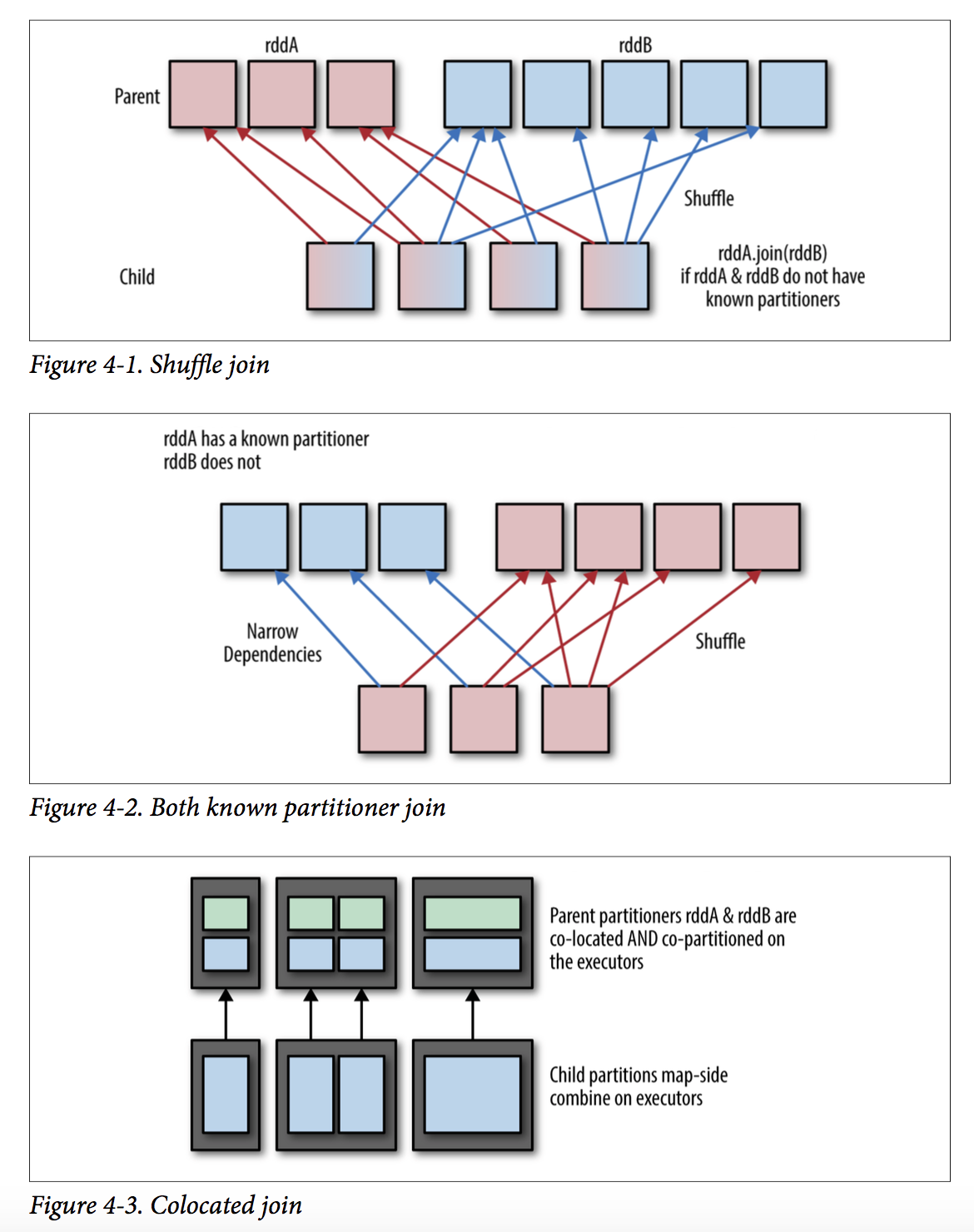
Choosing a Join Type
- 避免重复数据,distinct、combineByKey、congroup后进行join
- 支持join和leftOuterJoin、RightOuterJoin,左右关联时,有值返回Some(‘x’)否则Some(None)
- 过滤容易产生数据倾斜的值(有shuffle)
下面是Join相关API的简单应用测试:
package com.dt.spark.main.RDDLearn.PairRDDJoinFunAPI

import org.apache.spark.{SparkConf, SparkContext}

/**
  * Created by  on 16/12/06.
  */

//==========================================
/*
  PairRDD间关联API,注意返回值类型
  def join[W](other :Tuple2[K, W]) : Tuple2[K, Tuple2[V, W]]
  def join[W](other : org.apache.spark.rdd.RDD[scala.Tuple2[K, W]],
   numPartitions : scala.Int) : org.apache.spark.rdd.RDD[scala.Tuple2[K, scala.Tuple2[V, W]]]
   = { /* compiled code */ }

  def leftOuterJoin[W](other :Tuple2[K, W]) : Tuple2[K, Tuple2[V, Option[W]]
  def leftOuterJoin[W](other : org.apache.spark.rdd.RDD[scala.Tuple2[K, W]],
   numPartitions : scala.Int) : org.apache.spark.rdd.RDD[scala.Tuple2[K,
   scala.Tuple2[V, scala.Option[W]]]] = { /* compiled code */ }

  def rightOuterJoin[W](other : Tuple2[K, W]) : Tuple2[K, Tuple2[Option[V], W]]
  def rightOuterJoin[W](other : org.apache.spark.rdd.RDD[scala.Tuple2[K, W]],
  numPartitions : scala.Int) : org.apache.spark.rdd.RDD[scala.Tuple2[K,
  scala.Tuple2[scala.Option[V], W]]] = { /* compiled code */ }

  def fullOuterJoin[W](other : Tuple2[K, W]) : Tuple2[K, scala.Tuple2[Option[V], Option[W]]
  def fullOuterJoin[W](other : org.apache.spark.rdd.RDD[scala.Tuple2[K, W]],
   numPartitions : scala.Int) : org.apache.spark.rdd.RDD[scala.Tuple2[K,
   scala.Tuple2[scala.Option[V], scala.Option[W]]]] = { /* compiled code */ }

 */
object PairRDDJoinFunAPI {
  def main(args: Array[String]) {
    val conf = new SparkConf()

    conf.setAppName("test")
    conf.setMaster("local")
    val sc = new SparkContext(conf)
    //==========================================
    /*
  def join[W](other :Tuple2[K, W]) : Tuple2[K, Tuple2[V, W]]
  def join[W](other : org.apache.spark.rdd.RDD[scala.Tuple2[K, W]],
  numPartitions : scala.Int) : org.apache.spark.rdd.RDD[scala.Tuple2[K,
   scala.Tuple2[V, W]]] = { /* compiled code */ }

  def leftOuterJoin[W](other :Tuple2[K, W]) : Tuple2[K, Tuple2[V, Option[W]]
  def leftOuterJoin[W](other : org.apache.spark.rdd.RDD[scala.Tuple2[K, W]],
  numPartitions : scala.Int) : org.apache.spark.rdd.RDD[scala.Tuple2[K,
  scala.Tuple2[V, scala.Option[W]]]] = { /* compiled code */ }

  def rightOuterJoin[W](other : Tuple2[K, W]) : Tuple2[K, Tuple2[Option[V], W]]
  def rightOuterJoin[W](other : org.apache.spark.rdd.RDD[scala.Tuple2[K, W]],
   numPartitions : scala.Int) : org.apache.spark.rdd.RDD[scala.Tuple2[K,
    scala.Tuple2[scala.Option[V], W]]] = { /* compiled code */ }

  def fullOuterJoin[W](other : Tuple2[K, W]) : Tuple2[K, scala.Tuple2[Option[V], Option[W]]
  def fullOuterJoin[W](other : org.apache.spark.rdd.RDD[scala.Tuple2[K, W]],
  numPartitions : scala.Int) : org.apache.spark.rdd.RDD[scala.Tuple2[K,
  scala.Tuple2[scala.Option[V], scala.Option[W]]]] = { /* compiled code */ }
    */

    val KVPairRDD1 = sc.parallelize(List(("beijing", "京"),
    ("shaanxi", "陕"),("jiangsu", "苏"),("shandong", "鲁"),("guangxi","桂")))
    val KVPairRDD2 = sc.parallelize(List( ("beijing", "北京"),
    ("shaanxi", "西安"),("jiangsu", "南京"),("shandong", "济南")))

    def getVauleOfOption(in:Option[String]):String = in match {
      case Some(x) => x
      case None => "NULL"
    }

    val res = KVPairRDD1.fullOuterJoin(KVPairRDD2)
    .map(a=>(a._1,getVauleOfOption(a._2._1),getVauleOfOption(a._2._2)))
    res.foreach(println(_))
    //    (guangxi,桂,NULL)
    //    (shaanxi,陕,西安)
    //    (shandong,鲁,济南)
    //    (beijing,京,北京)
    //    (jiangsu,苏,南京)

    sc.stop()
  }

}
//==========
package com.dt.spark.main.RDDLearn.PairRDDJoinFunAPI

import org.apache.spark.rdd.RDD
import org.apache.spark.{HashPartitioner, SparkContext, SparkConf}

/**
  * Created by hjw on 17/9/16.
  */

object KnownPartitionJoin {

  /*
  有数据
  (id,score)和(id,address)
  得到得分最高的地址
   */
  def joinScoresWithAddress1( scoreRDD : RDD[(Long, Double)],
                              addressRDD : RDD[(Long, String )]) : RDD[(Long, (Double, String))]= {
    val joinedRDD = scoreRDD.join(addressRDD)
    joinedRDD.reduceByKey( (x, y) => if(x._1 > y._1) x else y )
  }
  /*
  减少join的数据量,想reduceBykey
   */
  def joinScoresWithAddress2(scoreRDD : RDD[(Long, Double)],
                             addressRDD: RDD[(Long, String)]) : RDD[(Long, (Double, String))]= {
    val bestScoreData = scoreRDD.reduceByKey((x, y) => if(x > y) x else y)
    bestScoreData.join(addressRDD)
  }
  /*
  避免缺失,用leftOuterJoin
   */
  def outerJoinScoresWithAddress(scoreRDD : RDD[(Long, Double)],
                                 addressRDD: RDD[(Long, String)]) : RDD[(Long, (Double, Option[String]))]= {
    val joinedRDD = scoreRDD.leftOuterJoin(addressRDD)
    joinedRDD.reduceByKey( (x, y) => if(x._1 > y._1) x else y )
  }

  /*
  用known parttion 避免shuffle join
   */
  def joinScoresWithAddress3(scoreRDD: RDD[(Long, Double)], addressRDD: RDD[(Long, String)]) : RDD[(Long, (Double, String))]= {
    // If addressRDD has a known partitioner we should use that,
    // otherwise it has a default hash parttioner, which we can reconstruct by
    // getting the number of partitions.
    val addressDataPartitioner = addressRDD.partitioner match {
      case (Some(p)) => p
      case (None) => new HashPartitioner(addressRDD.partitions.length) }
    val bestScoreData = scoreRDD.reduceByKey(addressDataPartitioner, (x, y) => if(x > y) x else y)
    bestScoreData.join(addressRDD)
  }


  def main(args: Array[String]) {
    val conf = new SparkConf()

    conf.setAppName("test")
    conf.setMaster("local")

    val sc = new SparkContext(conf)

    val coreRDD = sc.parallelize(List((1L,1.0),(2L,3.0),(3L,90.0),(4L,100.0)),2)
    val addressRDD = sc.parallelize(List((1L,"Japan"),(2L,"USA"),(3L,"Indian"),(4L,"China")),2)
    val resRDD = joinScoresWithAddress3(coreRDD,addressRDD)
    val res = resRDD.collect().apply(0)
    println(res._1 + "->(" + res._2._1 + " , " + res._2._2 + ")" )
    //4->(100.0 , China)

    while(true){;}
    sc.stop()
  }

}
Choosing an Execution Plan
Join默认要求相同的key在同一分区,因此默认是shuffle hash join,为避免shuffle:
(1)两个RDD有已知的分区(known partition)
(2)一方数据量很少可以直接放于内存,可以使用hash join
 /*
  用known parttion 避免shuffle join
   */
  def joinScoresWithAddress3(scoreRDD: RDD[(Long, Double)],
                             addressRDD: RDD[(Long, String)])
  : RDD[(Long, (Double, String))]= {
    // If addressRDD has a known partitioner we should use that,
    // otherwise it has a default hash parttioner, which we can reconstruct by
    // getting the number of partitions.
    val addressDataPartitioner = addressRDD.partitioner match {
      case (Some(p)) => p
      case (None) => new HashPartitioner(addressRDD.partitions.length) }
    val bestScoreData = scoreRDD.reduceByKey(addressDataPartitioner, (x, y) => if(x > y) x else y)
    bestScoreData.join(addressRDD)
  }

Speeding up joins using a broadcast hash join
broadcast hash join :将小的RDD(内存可容纳)的RDD传输到每个工作节点上去,和大RDD进行类似于hiveSQL的map-side combine。
SparkSQL可以根据以下两个参数控制:
(1)spark.sql.autoBroadcastJoinThreshold
(2)spark.sql.broadcastTimeout
Spark Core没有相关实现,但可利用map实现:
(1)collectAsMap小的RDD值driver
(2)broadcast
(3)mapPartions合并元素
  def manualBroadCastHashJoin[K : Ordering : ClassTag, V1 : ClassTag, V2 : ClassTag]
  (bigRDD : RDD[(K, V1)], smallRDD : RDD[(K, V2)])= {
    val smallRDDLocal: Map[K, V2] = smallRDD.collectAsMap()
    val smallRDDLocalBcast = bigRDD.sparkContext.broadcast(smallRDDLocal)
    bigRDD.mapPartitions(iter => {
      iter.flatMap{
        case (k,v1 ) =>
          smallRDDLocalBcast.value.get(k) match {
            case None => Seq.empty[(K, (V1, V2))]
            case Some(v2) => Seq((k, (v1, v2)))
          }
      }
    }, preservesPartitioning = true)
  }
Partial manual broadcast hash join
当RDD大于内存限制,可将较大RDD中高负载(数目最多一些如topN,countByKeyApprox或reduceByKey + sort取topN)keys,在小RDD中将这些key过滤出来,作为可存于内存的中间RDD分发做map-join,和剩余部分的普通join做union